Maren
The wind swept low across the heather-covered hills of western Jutland. In the small village of Lønborg, nestled between moors and forests, lived a girl named Maren. She was thirteen winters old and had never set foot beyond the churchyard wall. Her father, a stern tenant farmer, ruled their home with the quiet authority of necessity. Maren’s mother had died of fever when she was just five, and since then, Maren had run the household.
Every morning, before the rooster crowed, she fetched water from the well behind the cow pastures. She churned butter, baked black bread, and kept the hearth warm for her father and two younger brothers. Yet while her hands worked, her mind wandered to the horizon beyond the fields. She had heard stories—told in whispers by passing travelers—of the sea, of cities, of lands far beyond Ribe. Her heart ached with the pull of the unknown.
In her sleep, she dreamed of ships with bright sails and forests that hummed with birds she’d never seen. But in the light of day, duty shackled her like a chain forged in silence and obedience. “A girl belongs in the home,” her father often muttered, barely glancing up from his worn prayer book. And Maren, swallowing her yearning, would nod and knead the dough harder.
Her only true confidant was old Jens, the village bellringer, who had once sailed with the Hanseatic League. On quiet afternoons, when chores allowed, Maren would sit at his feet, listening as he smoked his pipe and told of Hamburg, Lübeck, and ports beyond the Sound. “You’ve got eyes that look beyond the ridge,” he told her once. “Don’t let them dim.”
But Jens grew sick in the spring of her fourteenth year and died before the barley was sown. Maren wept alone in the barn, fists clenched in the straw.
That summer, the harvest failed. Her father grew harsher, wearier, and her brothers more hungry and restless. The village seemed to shrink, as if the moor pressed in closer each day. Yet Maren’s spirit expanded, ripening with defiance. She began to sneak out at dusk, walking the ridges alone, listening to the wind.
One evening, she found an abandoned shepherd’s shelter by the river. Inside, tucked under a loose board, was an old map—tattered, ink-faded, but still legible. It showed the lands beyond Holstebro, and something stirred in her chest like wildfire. For weeks she studied the map by candlelight after everyone had gone to sleep. She began to gather: a bit of smoked fish, a flint, the wool cloak from her mother’s chest.
On the morning of the first frost, she rose before dawn and did her chores in silence. Then she kissed her brothers on the forehead, laid the cloak over her shoulders, and stepped out into the cold. She did not look back as the thatched roof of her home faded behind the mist. Her boots left prints in the hoarfrost, each one heavier with resolve. The moor stretched out before her like an unspoken promise. Birds wheeled above her, calling out like heralds.
She reached the ridge and stood there, breath clouding in the dawn. And then she walked on—into the unknown, into herself. The world, wide and waiting, had finally opened to her. And she, Maren of Lønborg, was no longer only a daughter of the farm—but a seeker, a wanderer, a soul unbound.
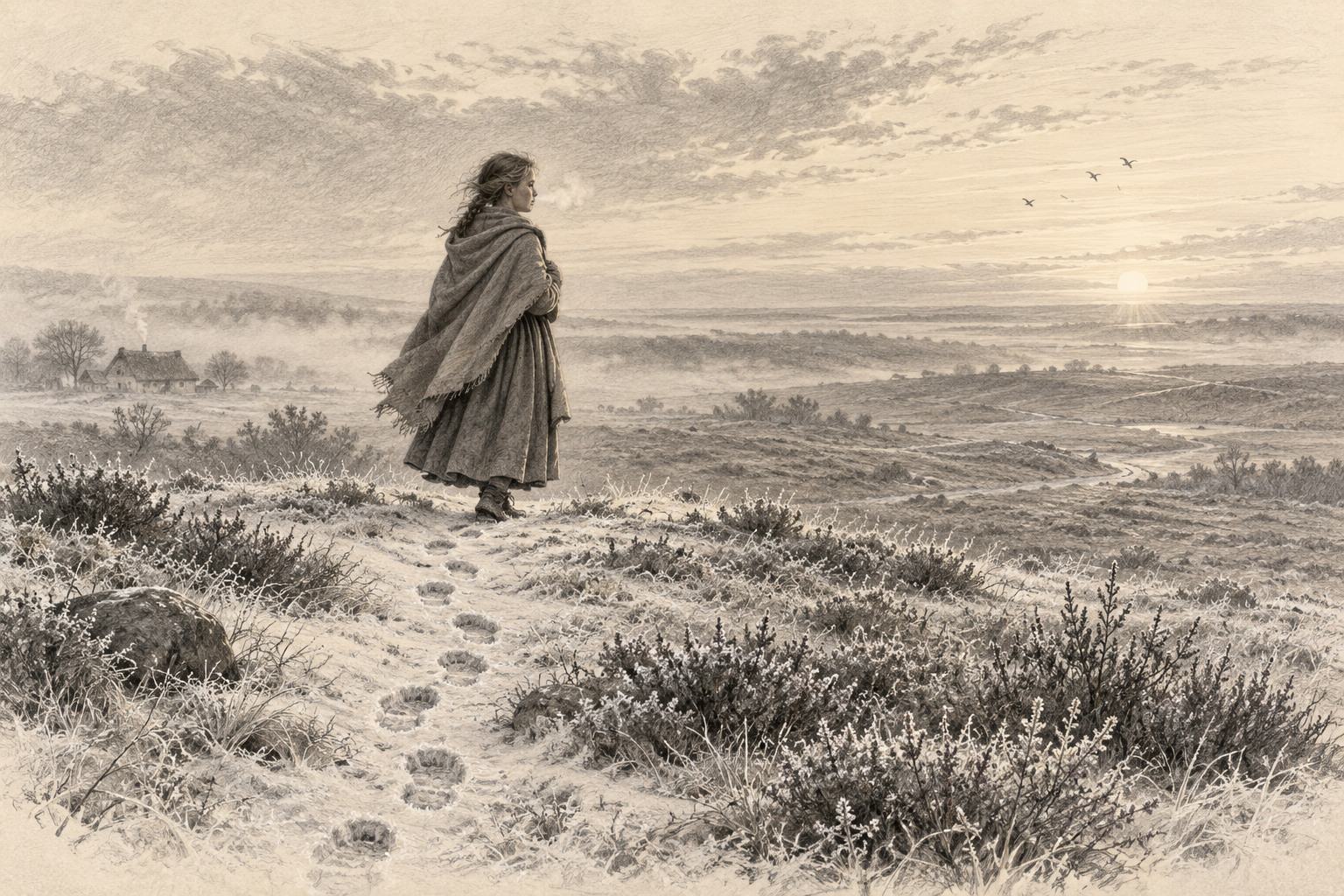
This work is a result of sending the following text to ChatGPT 4o and is a substitude for Lorem Ipsum.
begin with telling 40 sentences of a story about a young adolecent who wants to explore the world, but her duty must keep her at home. Eventual she breaks free and steps out into the world. Ths story should be set in rural Jutland in the 17th century
the illustration is a result of this prompt for GPT-6.1 Sol
read this story, identify the pivotal scene and make a beautiful poetic and thoughtful pencil drawing of it that can be used in telling the story.